Over the past two years, Lema Plan International has worked closely with schools, libraries, families, associations and other supporters across Switzerland to give books and educational materials a second life.
During this period, we often travelled directly to donors, collected materials ourselves, transported them, sorted them, stored them and prepared them for their next destination.
For materials intended for our educational projects, we also worked to continue that journey towards the beneficiaries.
These activities achieved much more than collecting books.
They helped Lema Plan International become better known.
They created relationships.
They expanded our network.
They gave us practical experience in collection, sorting, transportation and reuse.
And today, that experience is allowing us to take an important next step.
We are moving from simply collecting donations to managing donated resources strategically.

A Donation Can Create Impact in More Than One Way
When someone gives Lema Plan International a book, computer, tablet or other useful item, there does not have to be only one possible destination.
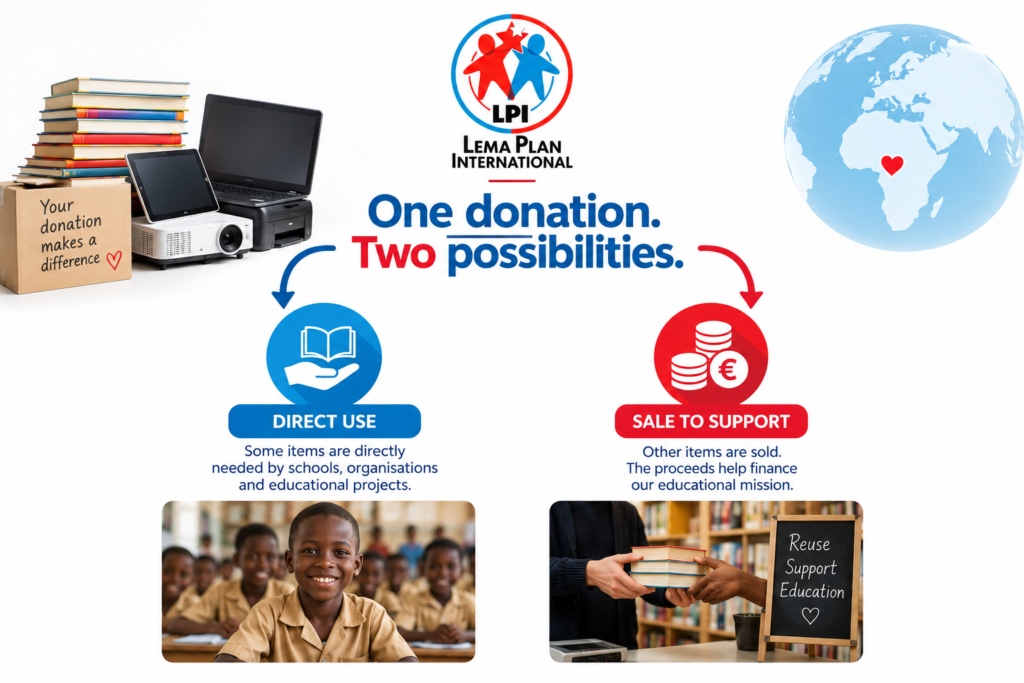
Some materials may be directly needed by an educational project.
Some may respond to a specific request from a school, organisation, partner or beneficiary.
But other donated materials may have value in a completely different way:
they can be sold.
That sale can generate financial resources for Lema Plan International.
And those resources can help finance our educational mission.
This is becoming an important part of our sustainability model.
A donated book does not necessarily need to travel thousands of kilometres to contribute to education.
A donated computer does not necessarily need to be shipped to Africa to create impact.
Sometimes its most useful second life may be with someone who wants to purchase it.
The item is reused.
Waste is reduced.
A customer receives something useful.
And Lema Plan International generates resources that can be reinvested in its mission.
Donate → Reuse → Sell → Finance Impact
Our developing model is simple:
Donate → Sort → Match to Demand → Reuse or Sell → Generate Resources → Finance Impact
This allows one donation to create several forms of value.
For example, a donated book may be exactly what an educational partner needs.
In that case, it can be allocated accordingly.
Another book may not be required for a current project but may have demand through our solidarity sales.
Instead of storing it indefinitely or transporting it somewhere simply because it was donated, we can give it a second life through a sale.
The proceeds can then contribute towards the organisation’s work.
The same principle can apply to computers, tablets, projectors, printers and other suitable reusable equipment.
The objective is not simply to move donated objects from one place to another.
The objective is to transform donated resources into sustainable impact.
Why Solidarity Sales Matter to Our Sustainability
Financial sustainability is essential to responsible educational work.
Educational projects require more than donated materials. Transportation, storage, local implementation, equipment, coordination and responsible organisational management all require financial resources.
This is why solidarity sales are becoming an important part of Lema Plan International’s model.
When a suitable donated book, computer or other reusable item is not required for a current project, giving it a second life through sale can create another form of impact.
The item is reused, while the revenue generated can help support the organisation’s educational work and the costs that make projects possible.
This means that not every new initiative has to depend entirely on a new fundraising appeal. Some of the resources already entrusted to us can also help generate funding for what comes next.
Our solidarity sales and online boutique are therefore not separate from our mission.
We Are Learning to Collect According to Demand
This also changes what we collect.
Previously, an organisation might think:
“Someone is offering books. Let us collect them.”
Our developing approach asks another question first:
“Is there a demand for these books?”
Demand can come from different places.
It may come from an educational project.
It may come from a school or community partner.
It may come from an institutional buyer.
It may come from a customer looking for a particular category of books.
Or it may come from someone in Switzerland looking for affordable second-hand materials.
Once demand is understood, collection becomes much more purposeful.
Demand → Source → Collect → Sort → Sell or Allocate → Generate Impact.
This helps us avoid accumulating large quantities of materials without a clear purpose.
The Same Applies to Computers and Educational Equipment
Our reuse model is also expanding beyond books.
Computers, desktop PCs, tablets and other equipment can all have valuable second lives.
At different moments, Lema Plan International may also actively look for particular categories such as projectors, printers or other educational technology.
But we do not need to collect every category continuously.
Once we have secured enough of one type of equipment, we can pause active collection and concentrate on:
Testing.
Preparing.
Cleaning.
Sorting.
Listing.
Selling or allocating.
Generating resources.
Then, when stock decreases or a new demand appears, collection can begin again.
Our cycle therefore becomes:
Identify Demand → Collect → Process → Sell/Allocate → Generate Resources → Reassess → Collect Again
This gives us greater control over stock, storage, labour and transportation.
Collection Must Still Make Economic Sense
There is another lesson from the past two years.
A donated item may be free.
Collecting it is not.
Switzerland has significant transportation and labour costs.
A collection journey requires time, fuel or transportation, loading, unloading and later sorting and storage.
Therefore, when deciding whether to make a dedicated collection journey, we increasingly need to consider the overall value created.
If the transportation and organisational cost of recovering a donation is disproportionate to its potential educational, reuse or resale value, making a special journey may not be the best use of the organisation’s resources.
This does not reduce our appreciation for the donor.
It is responsible management.
Where possible, we can instead group several donations within the same region:
One region → several donors → one collection journey.
We can also explore delivery, shipping, collection points and partnerships.
And where another local organisation can use the materials immediately, local reuse may sometimes be the most sensible option.
Please Continue Offering Us Your Donations
None of this means that Lema Plan International wants donors to stop contacting us.
Quite the opposite.
Please contact us before disposing of useful books or equipment.
You do not need to determine whether something has sufficient value yourself.
Tell us what you have.
Where possible, send:
- Photos
- Approximate quantities
- A brief description
- General condition
- Your location
We can then determine whether the materials correspond to a current project, customer demand, solidarity-sale opportunity or another useful second life.
We can also determine the most practical way to receive them.
Our Online Boutique Is Part of the Mission
Lema Plan International’s solidarity sales and online boutique are therefore becoming an important part of our long-term sustainability.
Selected donated and reusable items can be offered for sale rather than remaining unused.
Someone receives something useful.
An existing product gets another life.
And the revenue contributes to our educational work.
This creates a circular model:
Donation → Second Life → Sale → Revenue → Educational Impact
For us, this is not about turning generosity into ordinary commerce.
It is about making generosity work more than once.
A donor gives an item.
A customer gives that item another life.
And the organisation receives resources that can help finance its mission.
One contribution can therefore create several layers of impact.
What Tanzania Taught Us — and What We Are Applying to Togo
Our experience with the Tanzania project taught us an important lesson: collecting educational materials is only one part of an international project.
Books, computers and other donated resources may be free, but getting them where they are needed is not.
During our Tanzania operation, Lema Plan International faced additional logistics costs associated with transporting and delivering educational resources. The organisation had to absorb costs beyond what had initially been anticipated in order to complete the operation.
This experience reinforced something fundamental:
A successful project needs both materials and money.
Books cannot pay for transport. Computers cannot cover logistics. Donated equipment cannot finance local coordination or other costs that arise along the way.
We are now applying this lesson as we prepare our two school-library projects in Yalla, Togo.
Rather than focusing only on how many books we can collect, we must also ensure that the financial resources required to prepare, transport and implement the project are in place.
This is one reason our model is evolving.
Some donated resources can be allocated directly to educational projects. Others can be reused or sold, generating income that helps finance the logistics and implementation behind those projects.
Donate → Reuse or Sell → Generate Resources → Finance Educational Impact
For Lema Plan International, sustainability means bringing these two sides together: the resources communities need and the financing required to put those resources to work.
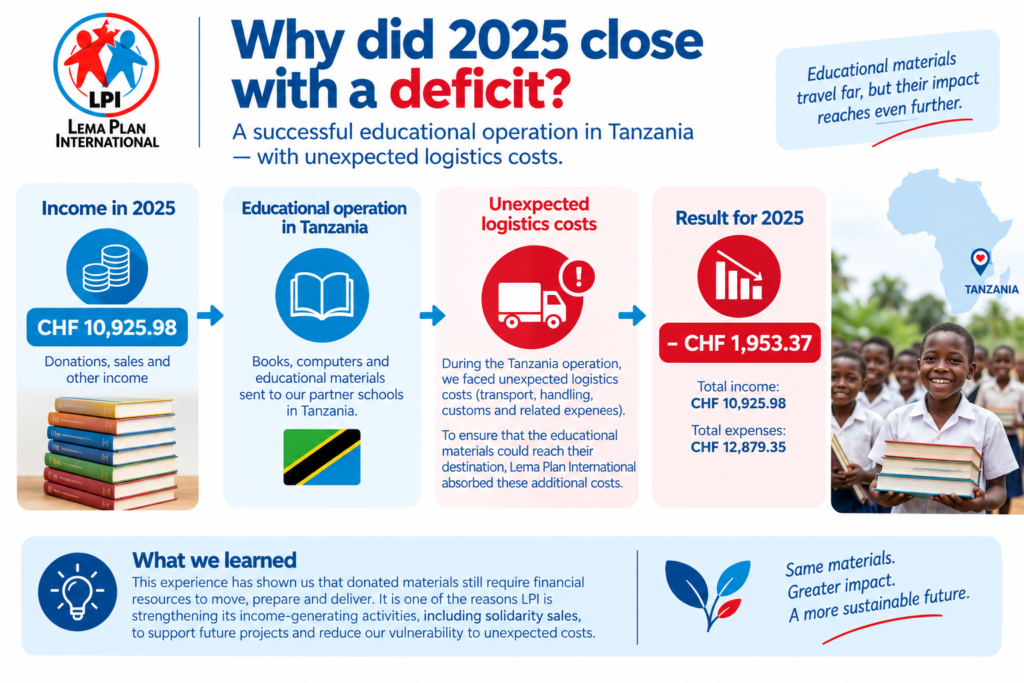
For full details of our 2025 activities, programme expenditure and financial position, please consult Lema Plan International’s 2025 Annual Report.
Demand Before Collection
This principle will guide future collection campaigns and new project opportunities, including potential future initiatives in countries where LPI has established relationships, such as Tanzania and Nigeria.
We do not want to collect thousands of books and then search for somebody who wants them.
We want to identify demand first.
If a partner, institution or customer requires a particular category and quantity, our Swiss network can then help us source appropriate materials.
This creates a much more efficient system:
Demand → Collection → Sale or Allocation → Revenue/Impact
The network we have spent the past two years developing therefore becomes much more valuable.
It is no longer simply a collection network.
It can become a sourcing and resource-generation network.
From Collection Organisation to Resource Organisation
This represents an important evolution for Lema Plan International.
The first stage was about building relationships and learning how to mobilise donations.
The next stage is about understanding how to use those donations intelligently.
Some will be donated.
Some will be allocated to specific projects.
Some will be reused locally.
Some will be sold.
And the proceeds from suitable sales can help finance our mission.
That is how we intend to make better use of what our community entrusts to us.
We do not need every donated book to travel to Africa.
We need the value created by that donation to contribute to impact.
Sometimes that value is the book itself.
Sometimes it is the computer itself.
And sometimes:
the value is the revenue that the donated item can generate.
A More Sustainable Lema Plan International
Our objective for the next stage is therefore clear:
Collect according to demand.
Avoid unnecessary transportation.
Group collections wherever possible.
Control inventory.
Give reusable materials a second life.
Sell suitable donated items.
Generate financial resources.
Reinvest those resources into our mission.
And collect again when there is a genuine need or market.
This is not about collecting less.
It is about extracting more impact from what we already collect.
It is not about abandoning donations.
It is about building a sustainable system around them.
And it is not simply about selling donated goods.
It is about ensuring that a donated resource can continue creating value long after it leaves the donor’s hands.
Have Something Useful to Donate?
If you have books, computers, tablets, projectors, printers or other reusable educational equipment, please contact Lema Plan International.
Send us a few photos, an approximate quantity, the condition and your location.
We will assess the most useful next step.
Your donation may support a project directly.
It may respond to an existing demand.
Or it may be given a second life through our solidarity sales and help finance our educational work.
Donate. Reuse. Sell. Reinvest. Create Impact.
Lema Plan International
Switzerland – Africa | Education, Reading & Sustainable Impact
Give Useful Resources a Second Life
Discover our solidarity shop and see how reuse can help support educational impact.